6.

USING SIMILARITIES OF TURBOMACHINES IN TURBOMACHINE DESIGN

–   page 6.3   –
–   page 6.4   –
–   page 6.5   –
–   page 6.6   –
–   page 6.7   –
–   Problem 613:   –
–   page 6.9   –
–   Problem 721:   –
–   Problem 262:   –
–   page 6.12   –
–   page 6.14   –
–   page 6.13   –
–  page 6.15-6.24  –
page 6.2
– author: –
ŠKORPÍK, Jiří (LinkedIn.com/in/jiri-skorpik)
–    issue date:    –
September 2022, December 2024 (2nd edition)
– title: –
Using similarities of turbomachines in turbomachine design
– proceedings: –
– provenance: –
Brno (Czech Republic)
– email: –
skorpik.jiri@email.cz

Copyright©Jiří Škorpík, 2022-2024
All rights reserved.

USING SIMILARITIES OF TURBOMACHINES IN TURBOMACHINE ...
page 6.3

Basic concepts

The design of the turbomachine is based on entered parameters. The number of entered parameters is usually insufficient for direct calculation of the dimensions, therefore the designer must obtain additional input parameters using similarity theory. Similarity theory uses so-called models for predicting the dimensions, performance characteristics of machines. The basic quantities in similarity theory are similarity coefficients.

Similarity theory as tool for experienced and educated observers
Similarity theory is a tool used by rational observers to predict the development of observed or future processes based on already known similar processes. However, observers must first be able to determine that the process is similar, which requires experience and education in the relevant field of natural or human sciences, as well as the ability to find connections. Similarity theory is used not only in technology, but also in medicine and other natural sciences.
Model as predictable section of reality with required properties
A model is a section of reality that we understand perfectly, is often well described by a theory, and in the time required we are able to determine its properties in the situations we are investigating, while at the same time we think of this section as having the same key properties in these situations as another section of reality we want to make real. Thus, the model can be a similar (model) machine or even a computational model, such as the calculation of a turbomachine for the case of potential flow (flow without losses), calculation under some other simplifying assumption, etc.
In engineering practice, similarity can be quantified using similarity coefficients such as number π
The model must have the same observer-defined similarity coefficients values with the target object or process. The similarity coefficients are for example the number π, which is the ratio of the circumference of a circle to its diameter (3,14159...). Thus, when calculating the circumference of a circle, we assume that circles are similar and that the above ratio holds for all its sizes. Another well-known similarity coefficient, is the Reynolds number used in evaluating flow properties. A typical feature of the similarity parameters is dimensionlessness, since it usually expresses the ratios between the selected quantities.
USING SIMILARITIES OF TURBOMACHINES IN TURBOMACHINE ...
page 6.4
turbomachines are similar, especially in their kinematics and geometry of shapes
All turbomachines are similar in principle, which distinguishes turbomachines from other machines. Most often we try to find similarities between two turbomachines if their working fluids have similar properties, have similar geometry and kinematics of the working fluid motion (so-called kinematic similarity). The similarity parameters for the found similarities can be defined by the designers themselves. Optimal values of these similarity parameters can be determined from a large amount of measured data from models or previous machines, so it is more common to start from already established similarity parameters and define new ones only when necessary. In the following sections of the paper, the most commonly used similarity parameters in the turbomachinery field are presented.

Geometrical similarities of turbomachine stages

Geometrical similarities are based on the similarity of the shape of blade cascades and the shape of velocity triangles.

Similar rotors will also have similar shapes of velocity triangles, etc.
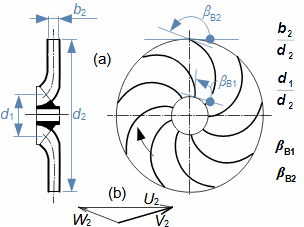
The shape of velocity triangle (Figure 1a) can be determined from the shape/type of rotor (Figure 1b) and vice versa. Other typical geometric similarities include include the direction of meridional flow, geometrical characteristics of blade cascades, density of profile cascade, etc., see Figure 1.
– 1: –
Typical geometrical similarity parameters of radial fan rotors
Typical geometrical similarity parameters of radial fan rotors: b [m] width; βB [°] profile angles; d [m] diameter; U [m·s-1] blade speed; W [m·s-1] relative velocity of working fluid; V [m·s-1] absolute velocity of working fluid. Index 1 indicates the inlet to the rotor, index 2 indicates the outlet.
USING SIMILARITIES OF TURBOMACHINES IN TURBOMACHINE ...
page 6.5
Values of geometric similarities
The values of geometric similarity parameters for bladed machines are provided in company design documentation and are also widely published in specialized literature; see the references at the end of the article and examples of values for a radial fan with forward curved blades in Table 2.
– 2: –
lit. βB1 βB2 d1/d2 b2/d2 Z
[Nový, 2007] ≤120 ≈160 0,8..0,9 ≈0,5 -
[Bleier, 1997] 60..120 160..120 0,75..0,9 - 24..64
Z [-] number of blades (smaller values for smaller rotors and vice versa); β [°].

Flow coefficient

The shape of the velocity triangle is determined by the geometry of the rotor, which was selected based on the geometrical similarity described above. The flow coefficient indicates the usual ratios of the individual sides of the rotor outlet velocity triangle.

Definition of flow coefficient
Flow coefficient is the ratio between the meridional velocity of the working fluid and the blade speed at the rotor outlet measured at the tip of the blades or the circumference of the radial rotor, Formula 3. However, for stages of radial centripetal turbines, the definition of the flow coefficient can be related to the rotor inlet (V1r, U1).
– 3: –
Definition of flow coefficient
(a) definition of flow coefficient; (b) application of flow coefficient to radial stage of working machine. ϕ [1] flow coefficient; V2m [m·s-1] meridional velocity of working fluid; V2r [m·s-1] radial component of velocity V2.
Alternative definition of flow coefficient
The given speed ratio is determined by the mass flow of the working fluid through the stage and the flow area, so the formula for ϕ can be converted to a more general form that gives the average value of ϕ for the entire stage, see Formula 4a. Instead of the actual flow area, a reference area equal to the area of a circle with the outer diameter of the rotor is also used, for example in fans. This is possible because the actual flow area A2 of fans is a function of the diameter d2, see Formula 1. In this case, however, ϕ no longer directly expresses the ratio of the selected sides of the output velocity triangle, but a multiple of this ratio, see Formula 4b. Due to this ambiguous definition of ϕ, it is necessary to include the formula when specifying the flow coefficient values so that it is clear which value is being referred to.
USING SIMILARITIES OF TURBOMACHINES IN TURBOMACHINE ...
page 6.6
– 4: –
Alternative definition of flow coefficient
(a) general formula for flow coefficient; (b) alternative formula for flow coefficient used for radial stages. m [kg·s-1] mass flow through stage; A2 [m2] flow area at stage outlet; ρ2 [kg·m-3] density at stage outlet. The derivation of the alternative formula for the flow coefficient is shown in Appendix 341.
Values of flow coefficients
Table 5 shows the optimum flow coefficient values according to Formula 4b for radial fans with forward curved blades.
– 5: –
[Japikse, 1997] [Ibler, 2002] [Nový, 2007]
ϕ 0,7...1 0,4...1 0,32...1
 

Head coefficient

Using the previous similarity parameters, it is possible to propose a suitable shape of the velocity triangle and their aspect ratios. In order to design the size of the velocity triangle, it is necessary to know the size of at least one velocity – this can be done, for example, using the head coefficient.

Definition formula for head coefficient
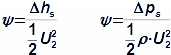
The head coefficient is defined by Formula 6 as the relationship between the change in stagnation enthalpies of stage (Euler work) and the blade speed at outlet – in the case of centripetal radial turbines at the rotor inlet.
– 6: –
Head coefficient
right - special definition of reaction used for hydraulic machines. ψ [1] head coefficient; Δhs [J·kg-1] difference of stagnation enthalpies of stage; Δps [Pa] change of stagnation pressure.
How to work with difference in stagnation enthalpies
The difference of stagnation enthalpies Δhs in the numerator corresponds to the difference of stagnation enthalpies of the whole machine in the case of single-stage turbomachines. The difference of stagnation enthalpies in the case of working machine stages is taken to be the absolute value respectively the positive value.
Optimal values of head coefficients
Table 7 shows the optimum values for the head coefficient of radial fans with forward curved blades according to different authors. The numbers in the table vary because some authors use a slightly different definition (for example, they base the definition on the difference in static pressures or omit the constant 1/2 in the denominator, etc.).
USING SIMILARITIES OF TURBOMACHINES IN TURBOMACHINE ...
page 6.7
– 7: –
[Japikse, 1997] [Ibler, 2002] [Nový, 2007]
ψ ≈2 2...3 0,5...2,5
 

Specific speed

The specific speed is the speed of the described stage at which the stage would have a power of 1 W, while being loaded with an energy differential of 1 J·kg-1 and the rotor would be decreased/increased to a diameter of 1 m (it is possible to find other model stage parameters in other units in the literature).

Definition formula of specific speed
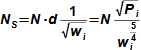
Specific speed is defined by Formula 8. In the case of single stage machines, the energy differential is based on the whole machine.
– 8: –
Definition of specific speed
NS [min-1] specific speed; N [min-1] actual machine rotational speed; wi [J·kg-1] internal work of stage (machine); d [m] reference diameter (most often rotor diameter); Pi [W] internal power of stage/machine. The derivation of the formula is shown in Appendix 870.
Special variants of specific speeds according to industry standards
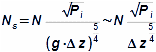
Internal work in hydraulic machines is recalculated, for example, to the available water head (for water turbines) based on the Bernoulli equation (foe example Formula 9 for water turbines), or the stagnation pressure change (for pumps and fans). The formula for the specific speed of the fan stage is modified so that the volume flow rate appears instead of the power Pi. Sometimes, the formula for specific speed is even modified so that it no longer has the unit min-1, but for clarity, the term speed with the unit min-1 is still used. This is also the case with the Formula 9 for the specific speed of water turbines, where gravitational acceleration, which is ‘the same’ across the entire planet and has no effect on the comparison of two water turbines, is omitted. By removing gravitational acceleration, the specific speed can no longer have the unit min-1.
– 9: –
Specific speed of water turbines
g [m·s-1] gravitational acceleration; Δz [m] difference in water levels. Since water turbines are single-stage machines, the expected power at the coupling is usually compared.
USING SIMILARITIES OF TURBOMACHINES IN TURBOMACHINE ...
page 6.8
Relationship between specific speed, internal losses, and rotor type
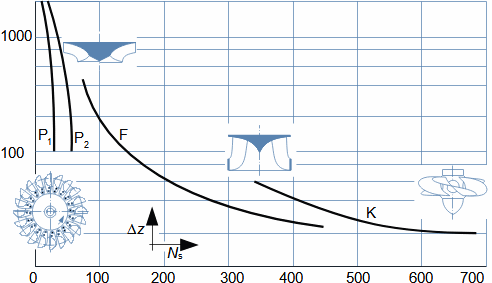
Internal losses in turbomachines are primarily a function of flow velocity. Flow velocity is a function of the energy difference (specific work) of the stage and the mass flow (the lower the rotational speed and the smaller the flow area of the stage, the higher the velocity). These parameters are included in the formula for specific speed, which is why specific speed is used when selecting the most suitable rotor shape for the given requirements. This is based on the specific speed of models or other machines in operation, in which the given rotor type achieved optimal parameters. For example, the direct dependencies between the specific speeds of individual types of water turbines are evident from Figure 10.
– 10: –
Optimal specific speed of water turbines according to available head
P1; P2 – Pelton turbine with one and two nozzles; F – Francis turbine; K – Kaplan turbine. The specific speeds for this chart are calculated using Formula 9, where the power must be entered in kW and the rotational speed in min-1. Data source in [Horák et al., 1961].
–   Problem 613:   –
Use the specific speed to determine what type of water turbine is likely to be installed at the Lipno I hydroelectric power plant. If the turbine is designed for a flow rate of up to 46 m3·s-1 at a head of 160 m and a rotational speed of 375 min-1. When calculating, use a values of 9,81 m·s-2 for gravitational acceleration and a value of 1000 kg·m-3 for water density.
The solution of this problem is shown in Appendix 613.
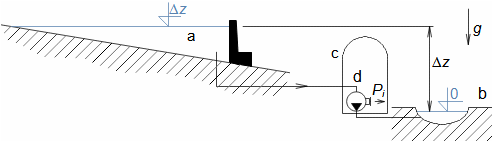
Water dam
a-upper reservoir; b-lower reservoir; c-machine room; d-water turbine.
USING SIMILARITIES OF TURBOMACHINES IN TURBOMACHINE ...
page 6.9
Relationship between specific speed and internal efficiency
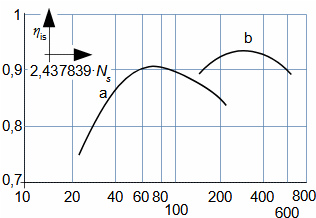
In general, it can be said that axial stages have higher internal efficiency at higher specific speeds than radial stages, and vice versa. This is mainly due to the fact that the Euler work of a radial stage will be greater than that of an axial stage at the same relative velocity in the blade passages due to the change in blade speeds, which has an impact on stage losses, see Figure 11. The relationship between specific speeds and the internal efficiency of the machine is demonstrated, for example, in [Ingram, 2009]. The values of optimal specific speeds for different types of blade machines are given, for example, in [Japikse, 1997], [Pfleiderer and Petermann, 2005].
– 11: –
Internal efficiency of compressor stages as function of specific speed
Internal efficiency of compressor stages as function of specific speed: a-radial stage with axial inlet; b-axial stage. ηis [1] internal efficiency of compression stage. Data source in [Japikse, 1997, p. 1-23].

Operational similarities of turbomachine stages

The similarity of turbomachines can be used to predict the values of operating variables , internal losses and efficiency of turbomachines and to optimise their operating states.

Operating variables as a function of flow and head coefficients
The performance characteristics of turbomachines depend on changes in two or more monitored operational variables of the machine, such as power, internal work, compression ratio, increase in total pressure at mass flow, etc. In some cases, based on the theory of similarity, it is possible to derive equations of performance characteristics as a function of head or flow coefficient at constant rotational speed, see Formulas 12.
– 12: –
Operating variables of turbomachine stages
εs [1] compression ratio; cP [J·kg-1·K-1] heat capacity at constant pressure; Ti,s [K] stagnation absolute temperature of working gas at stage inlet; n [-] polytropic exponent. The formula for wi is derived considering only profile losses; the derivation is shown in Appendix 668.
USING SIMILARITIES OF TURBOMACHINES IN TURBOMACHINE ...
page 6.10
Ideal dimensionless characteristics of turbomachine stages in the ψ-ϕ chart
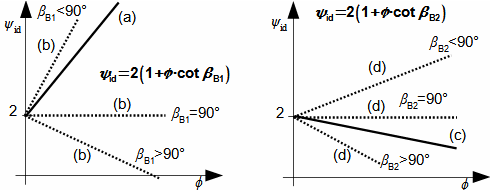
The dependence of the head coefficient on the flow coefficient is called a dimensionless characteristic, which is ideally a function of the angles of the blade profiles, see Formulas 13.
– 13: –
Ideal dimensionless characteristics of turbomachine stages (for N=const.)
left – ideal performance characteristics of turbine stages; right – ideal performance characteristics of working machine stages. (a) axial turbine stage; (b) radial centripetal turbine stage; (c) axial working machine stage; (d) radial centrifugal working machine stage. ψid [1] head coefficient in case of lossless flow. The formulas are derived under the assumptions that the inlet and outlet angles of the flow are identical to the profile angles (β=βB) and at V=0 for turbine stages and at V=0 for working machine stages and for N=const. The derivation of the formulas is shown in Appendix 803.
Ideal dimensionless characteristics of turbine axial stages
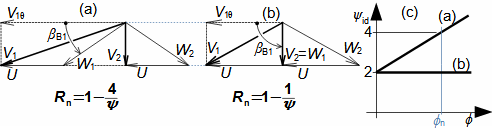
The slope of the axial stage characteristic can be influenced by the size of the angle βB. This angle also influences the value of the reaction R, respective stage load. Figure 14 compares two cases of ideal axial stages of turbines with straight blades with reactions of 0 and 0,5. The derived equations show that a stage with a reaction stage of 0 at the same flow coefficient (same mass flow, same blade length and mean radius) will have twice the head coefficient (twice the internal work) than a stage with a reaction of 0,5, so its characteristic will also be more steep, because both characteristics must start at ψ=2. In general, it can be expected that with stages with twisted blades, as the average reaction value decreases along their length, their internal work will increase while maintaining the length, blade radius and blade speed.
– 14: –
Axial stage turbines with reaction stages 0 and 0,5
(a) reaction 0 at nominal condition; (b) reaction 0,5 at nominal condition; (c) ψ-ϕ characteristics. The index n denotes the nominal (design) condition. The equations are derived in Appendix 434.
USING SIMILARITIES OF TURBOMACHINES IN TURBOMACHINE ...
page 6.11
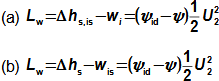
Internal losses as difference between head coefficient of ideal and real machine
The ideal characteristic does not take into account losses that occur during flow. The difference between Δhs,is and wi (in Formulas 6) are internal losses of the stage, so these losses can also be expressed from the difference in head coefficient between ideal flow and real flow, see Equation 15.
– 15: –
Relationship between turbomachine stage losses and similarity parameters
(a) for turbine stages; (b) for working machine stages. Lw [J·kg-1] internal losses of stage.
Actual dimensionless characteristics of turbomachine stages
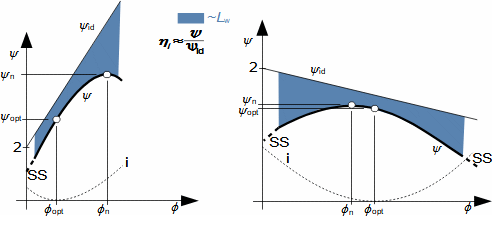
Losses vary with mass flow, but if we have two similar stages (machines), this dependence will be similar, so if we measure the performance characteristics of one reference stage and create a dimensionless characteristic from it (Figure 16, Figure 17), then we can quite accurately predict the performance characteristics of a completely new stage (Problem 721) and its internal efficiency using Equations 12. Using Equations 15, we can also numerically express the expected losses for the new designed stage.
– 16: –
Actual dimensionless characteristics of turbomachine stages
Left-example of axial turbine stage characteristics; right-example of radial working machine stage characteristics (βB2>90°). SS-stage stall area – due to incorrect combination of angle of attack i and mass flow, flow separation from blades occurs; i-loss curve due to incorrect angle of attack. ηi [1] internal efficiency of stage (formula valid for turbine and working stages). The index opt denotes optimal. The characteristics are for N=const.
USING SIMILARITIES OF TURBOMACHINES IN TURBOMACHINE ...
page 6.12
– 17: –
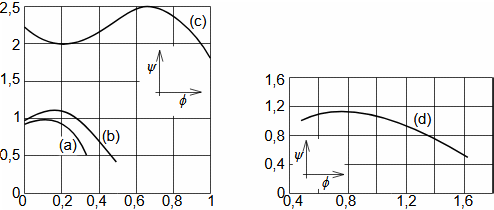
Actual dimensionless characteristics of working machine stages
left-dimensional characteristics of fan stages according to [Čermák et al., 1974], flow coefficient ϕ calculated according to Formula 4b; right-dimensional characteristics of compressor stage according to [Dixon and Hall, 2010]. (a) radial backward curved blades (βB2>90°); (b) radial blades (βB2=90°); (c) radial forward curved blades (βB2<90°); (d) axial stage.
–   Problem 721:   –
Calculate the probable operating characteristics Δps-Q of a fan with forward curved blades. The expected nominal parameters are Δps,n=150 Pa, Qn=100 m3·h-1. Use the dimensionless characteristic ψ-ϕ in Figure 17 for the calculation.
The solution of this problem is shown in Appendix 721.
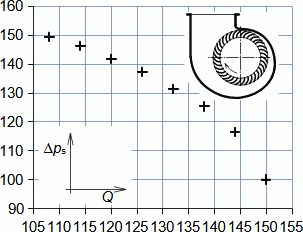
Performance characteristics of fan with forward curved blades
Δps [Pa]; Q [m3·h-1]
USING SIMILARITIES OF TURBOMACHINES IN TURBOMACHINE ...
page 6.13
Determination of position of optimal and nominal operating parameters in ψ-ϕ chart
The ratio ψ/ψid must approximately correspond to the internal efficiency of the stage ηi, because the difference between the actual and ideal head coefficient is equivalent to losses. From this, it can be expected that machines with the ideal head coefficient equal to 2 must correspond to the nominal (maximum) and optimal performance. For stages with a positive slope of the ideal head coefficient, optimal performance can be expected at lower mass flows than the nominal ones. For stages with a negative slope of the ideal head coefficient, optimal power can be expected at higher mass flows than the nominal ones. This behavior is mainly caused by a change in the camber of flow when the angle of attack changes – in the first case, the camber of flow increases with flow rate until flow separation occurs, in the second case, the camber of flow increases as the mass flow rate decreases, etc. From the values ψopt, ϕopt, it is possible to calculate the dimensions of the new machine at which it will most likely achieve optimal parameters (Problem 3).
–   Problem 262:   –
Calculate the dimensions of the rotor of a pressureless radial fan with forward curved blades, for parameters identical to those in Problem 721, p. 12. Estimate the expected internal losses at optimal parameters. Calculation the fan for air with a density of 1,2 kg·m-3.
The solution to the problem is shown in Appendix 262.
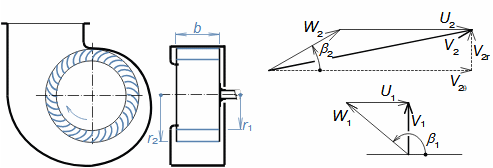
Radial fan with forward curved blades
 
Prediction of power sensitivity to changes in mass flow
The expected shape of the real dimensionless characteristic also depends on the value of the ideal power coefficient slope, as shown in Figure 16. The greater the slope value, the more steep the actual dimensionless characteristic will be. For example, in the case of an axial stage with a reaction of 0, the power will be more sensitive to changes in mass flow than a stage with a reaction of 0,5, etc., see the conclusions in Figure 14.
USING SIMILARITIES OF TURBOMACHINES IN TURBOMACHINE ...
page 6.14

Note on use of similarity parameters in design of new machine

Similarity parameters significantly supplement the entered parameters, but using many on one machine can cause overdetermination, as many are interdependent.

Specific speed as function of head coefficient
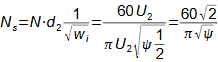
A typical error in applying similarity theory is the simultaneous estimation of NS and ψ, resulting in an overdetermined problem – for the case d=d2 (e.g. working machines), Formula 18 can be derived by substituting the formulas for blade speed U and internal work wi (Formula 12) into Formula 8 for specific speed. It follows that the designer can use either the optimal values of specific speed or head coefficient.
– 18: –
Specific speed as function of head coefficient
Purpose of similarity theory in digital age
Nowadays, powerful computers and specialised software based on FEM principles can be used to find the optimal design of a turbomachine via an iterative procedure, even without knowledge of similarity theory. Conversely, familiarity with similarity theory enables designers to select initial optimisation variants more effectively, resulting in the software solving fewer variants more quickly, or facilitating the detection of insufficient parameters in the machine under investigation.

References

ŠKORPÍK, Jiří, 2024, Technická termomechanika, engineering-sciences.education, Brno, https://engineering-sciences.education/technicka-termomechanika.html.
BLEIER, Frank, 1997, Fan handbook, selection, aplication, and design, The McGraw Hill companies, ISBN 0-07-005933-0.
ČERMÁK, Jan, HELLER, Václav, NOVOTNÝ, Slavomil, PITTER, Jaroslav, SEDLÁČEK, František, ŠAVRDA, Miloš, 1974, Ventilátory, SNTL-Nakladatelství technické literatury, n.p., Praha.
DIXON, S., HALL, C., 2010, Fluid Mechanics and Thermodynamics of Turbomachinery, Elsevier, Oxford, ISBN 978-1-85617-793-1.
HORÁK, Zdeněk. KRUPKA, František, ŠINDELÁŘ, Václav, 1961, Technická fysika, SNTL, Praha.
INGRAM, Grant, 2009, Basic Concepts in Turbomachinery, Grant Ingram & Ventus Publishing Aps, ISBN 978-87-7681-435-9.
IBLER, Zbyněk, KARTÁK, Jan, MERTLOVÁ, Jiřina, IBLER, Zbyněk ml., 2002, Technický průvodce energetika-1. díl, BEN-technická literatura, Praha, ISBN 80-7300-026-1.
JAPIKSE, David, 1997, Introduction to turbomachinery, Oxford University Press, Oxford, ISBN 0-933283-10-5.
NOVÝ, Richard, 2007, Ventilátory, České vysoké učení technické v Praze, Praha, ISBN 978-80-01-03758-4.
PFLEIDERER, Carl, PETERMANN, Hartwig, 2005, Strömungsmaschinen, Springer Verlag Berlin, Heidelberg, New York, ISBN 3-540-22173-5.
©Jiří Škorpík, LICENCE